China Found the Dollar’s Replacement — The Global Reserve Currency Is Shifting
From BRICS settlements to yuan oil trades, de-dollarisation is no longer theoretical.
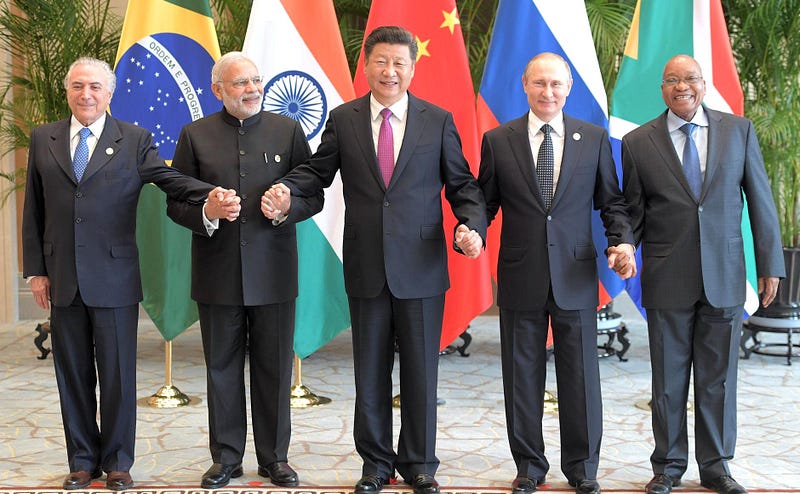
For nearly a century, the US dollar has been the most powerful currency in the world. However, China is now promising to take the place of the US dollar.
They’re not just talking about it; they’re putting their money where their mouth is.
After the United States attacked Iran, our economy and inflation took a beating.
China used our economic pain as an opportunity to then go out and buy a lot more gold.
That way, they can strengthen their currency while we are hurting. But that’s not all.
The president of China says that the world should be prepared because the current international order, meaning the United States dollar’s dominance.
You should be aware of this because these changes impact not only our economy but also our currency, which could have an impact on your pay cheque, not because the dollar is going to plummet tomorrow or anything like that.
You should pay attention to this because it affects your savings, inflation, stock market, and retirement.
And that way, you can also find opportunity through the changes that are happening right now.
In recent years, there has been a growing alliance called BRICS. That’s Brazil, Russia, India, China, and South Africa, which are actively working to overthrow the United States dollar.
BRICS started as a group of just five countries: Brazil, Russia, India, China, and South Africa.
A lot of people said it was a conspiracy theory, but now it’s a group of about 20 countries.
In addition to thinking about creating their own currencies to compete with the US dollar, some of the BRICS countries — like China — are actively strengthening their own currencies.
That way, they can individually compete against the United States dollar.
And in simple terms, to explain China’s three-part plan in order to one day replace the United States dollar, they’re trying to do these 3 things.
Number 1: They want to build a currency that countries around the world trust.
As you may have noticed, China has been attempting to establish numerous agreements with nations worldwide as a means of conducting business.
It may even sell oil in Chinese yuan rather than US dollars since more people using the Chinese yuan increases its credibility. And that’s their plan’s initial component.
Number 2: The Chinese government has been working to back their currency, the Chinese yuan, with gold.
One of the big concerns with the United States dollar is that the dollar is not backed by any precious metal.
It’s not backed by really anything; it’s backed by a promise by the United States government, which allows us in the United States to print and spend pretty much an unlimited amount of money.
But that creates concerns about what the real value of a dollar is if you can just print more of those dollars without needing more wealth.
And this is where China has been working to acquire more gold as a way to continue producing more trust in their currency, to kind of show that they’re backing their currency with gold, and to show that their currency has value.
Because of this actual gold, not just a promise. It’s interesting to note that whenever the US economy is struggling, China takes advantage of the situation by purchasing more gold to demonstrate to the rest of the world that it is bolstering its currency while the US dollar is weakening due to inflation.
Now, for full transparency, according to the United States Treasury, the United States owns way more gold than China does today.
However, we haven’t bought any more gold in the last 50 some years.
Now, this is where you start to see a lot of very emotional headlines talking about how the dollar is going to collapse.
But let me really put it in perspective with some real numbers, so you see where the dollar is relative to the Chinese yuan and how things have been progressing over the last couple of decades.
In the year 2005, the United States dollar made up about 66.5% of the global currency reserves.
This means that countries around the world stored their wealth in the United States dollar, and that was about 66.5% of the global reserve currency.
We can compare that to the Chinese yuan, which in 2005 was about 0% of foreign reserves.
Now, let’s fast forward 10 years to the year 2015. Now, the global foreign reserves of the United States dollar fell from 66.5% to 65.7%, and the Chinese yuan was about 0% of the global reserves.
So, you can start to see still not much competition from China. But take a look at what happened now in the year 2025.
By the year 2025, we now see the United States dollar reserves globally fall all the way down to 56.8%, while the Chinese yuan reserves have now started to rise to about 1.9%.
So the concern isn’t the number, the concern is the trend, because United States dollars have been trending downwards, while it looks like the Chinese yuan is starting to trend upwards.
That’s the concern that people have while China is working to do these 3 things.
Which is why now people are getting concerned about where this is going to be, not next year but 10 years from now, as the Chinese economy is still growing faster than the United States’ economy.
And to be clear, there are two main reasons why China wants to distance itself from the United States dollar.
- Reason 1: Is because of potential sanctions.
Following Russia’s attack on Ukraine, we witnessed the United States stating, “Hey, Russia, we don’t like what you did, so we’re going to punish you by freezing United States assets, by freezing United States dollars.”
This was a means of penalizing the Russian economy for its assault on Ukraine.
However, all these other nations, including China, have suddenly declared, “Hey, you don’t like what Russia did, so you’re going to punish Russia by freezing its US assets.”
That’s a concern for us, China, because we are still holding on to a lot of United States dollars. The Chinese government is still one of the largest lenders to the United States government.
And so, if China could see its assets frozen if it did something that the United States didn’t like, that poses risks and concerns to the Chinese economy.
- Reason 2: Is that there’s a lot of power in being the world’s reserve currency.
What the world’s reserve currency means is that the United States dollar is the world’s reserve currency, which means global trade happens in the United States dollar.
If you want to go out and buy oil, most of the time you have to buy in the United States dollar.
Although just a few years ago, we started to see some countries starting to sell oil not in the United States dollar, but in the Chinese yuan.
But what it means is that global trade is happening in the dollar; countries are saving their money in the United States dollar.
All that means is that there’s more trust, more value, and more power in the United States dollar.
This allows our Federal Reserve Bank to print more money, allows the US government to spend more money that it does not have, and allows us to boost our economy because we can simply create money out of thin air without experiencing serious inflation issues.
Now, you might say, we are facing some inflation problems. Yes, we are.
But imagine how bad our inflation problems would be if we were spending and printing money the way that we are today, and people did not have trust and faith in the United States dollar.
The inflation problem would be significantly worse. So we are able to boost our economy artificially by having a strong currency, and that’s the benefit of being the world’s reserve currency.
If China had the world’s reserve currency, well then, they could do what the United States is doing.
Because it allows you to expand your economy and enrich your people without really creating additional income, people desire to be the world’s reserve currency and economic superpower. The printing process is one way to accomplish that.
So, what does this mean for you? Besides the fact that this could create potential investment opportunities, the thing that you want to pay attention to is where this trend is going.
Is the United States going to continue printing money, spending money, and creating concerns about the dollar? If so, we might continue to see these foreign reserves of the United States dollar continue to fall.
If that happens, that means people are losing trust in the United States dollar globally. And if we continue to see this number rising, well, that can show you where the tide is moving over the coming years.
Again, this isn’t something that’s going to happen overnight, but this is something that could happen over years and decades, which could create a change in the way that our government spends money.
It could create a change in the way that your savings are valued and your paycheck is valued. So, that’s something you want to pay attention to.
But now that you understand that, how could this create potential investment opportunities as you’re thinking about your investments in this global economy?
Let me break this down into 3 different parts.
#1. If you wanted to invest in the Chinese economy, if you believe that more money is going to grow into the Chinese economy, there are a couple of ETFs that will give you exposure to the Chinese economy.
- MCHI.
This is an ETF that’s going to give you broad exposure to the Chinese economy.
This is going to give you broad exposure to large-cap Chinese internet companies, banks, insurers, and industrials. Pretty much all the major industries in the Chinese economy.
2. FXI.
This is another ETF that’s going to give you exposure to the Chinese economy.
This time, it’s going to be investing in the 50 largest Chinese companies that are listed in Hong Kong.
So, you could think of this as a way to get exposure to the blue-chip companies in the Chinese economy.
Maybe you’re not so keen on China, but you want to invest in what the BRICS nations are doing because you want to know what’s going on with BRICS, and you say, you know what, that could create an investment opportunity. Well, there are a couple of ways that you can play that.
You can invest in individual companies.
- For example, EWZ is going to give you exposure to Brazil.
- INDA is going to give you exposure to the I, the Indian economy. These are two country-specific ETFs that are going to give you exposure to those local economies, or if you want to invest in the emerging markets, an ETF like VWO will give you exposure to that.
- VWO is giving you exposure to many of the major BRICS economies, that’s countries like China, India, Brazil, Saudi Arabia, the UAE, and many others. So if you want to get exposure to those emerging markets, VWO can give you exposure to that.
Or maybe you’re saying to me, “I don’t really want to invest in these different types of countries, I’m just concerned about how all of these changes are going to impact inflation.
Well, one of the things that investors like to do when they’re concerned about inflation is invest in hard assets.
This would be things like physical gold, and this could be things like real estate.
Now, when you invest in these hard assets, it does take more time and work, but there are also ways to get exposure to different types of hard assets, specifically commodities, in the stock market.
Let me go over a few different examples to help you start thinking like an investor.
Number 1: If you want to get exposure to gold, there are ETFs like GLD that are going to give you exposure to physical gold.
There are exchange-traded funds (ETFs) like PSLV that can provide you with exposure to silver.
Alternatively, there are ETFs like DBC that will expose you to a wide variety of commodities if you simply want broad exposure.
These include items like agriculture, metallurgy, and energy. Because of what we’ve observed, commodities tend to be more stable during currency crises, although this isn’t always the case.
Therefore, the US dollar has been the most powerful currency in the world and the reserve currency for more than a century.
However, we are beginning to witness an increasing number of nations, such as China, voicing their desire to replace the US dollar.
In the past, people would only discuss conspiracies in whispers and rumours, but now that the Chinese president is criticizing the United States, the conspiracy is growing in scope and volume.
In addition to criticizing the current global order, the BRICS countries are beginning to grow and openly declare their desire to replace the US dollar.
Maybe that’s going to be through trying to create their own currency or through individual countries like China working to strengthen their own currency.
Well, what China is trying to do is, number one, they want to build more trust in the Chinese yuan by building more of these trade agreements in the Chinese yuan.
Number 2: They’re trying to back the Chinese yuan with physical gold.
Number 3: They’re trying to buy more physical gold, especially during times where the United States economy begins to hurt, as a way to show the rest of the world, “we are working to strengthen our currency while the United States is hurting”.
All of this is happening because of two main reasons.
#1: The Chinese economy does not want to be sanctioned by the United States if they do something that the United States doesn’t like.
#2: When you are the world’s reserve currency, you have a lot of power, you can spend and stimulate your economy, and you can grow your economy because of your world’s reserve currency status.
Thus, these are the events that are taking place. Once more, this won’t be a dramatic one-night transformation, but over the previous few decades, this trend has begun to emerge.
The US dollar’s international reserve holdings have been declining, while more lately, the Chinese yuan’s foreign reserve holdings have begun to increase.
Now, the question is what’s going to happen 10 years from now? Because the Chinese economy has been expanding more quickly than the US economy, if that trend continues, the US dollar may face additional challenges.
Therefore, the question is where we will be in 2035 or 2045, depending on how things turn out between now and then, rather than what will happen in 2026 or 2027.
Now, all this being said, how can this create potential investment opportunities? If you think there are issues with the US dollar, this could lead to possibilities for growth elsewhere.
We discussed many strategies for investing in the Chinese economy, various strategies for investing in the other BRICS countries or emerging markets in general, and various strategies for gaining exposure to commodities.
If you got value from this story, again, the best thank-you is a referral.
Thank you, Reading 🙂 & FOLLOW ON SUBSTACK
This Article In Originally Published On Medium.