The Philosophy of Smart Investing — Quotes That Stand the Test of Time
The investing wisdom that guided the world’s greatest wealth builders.

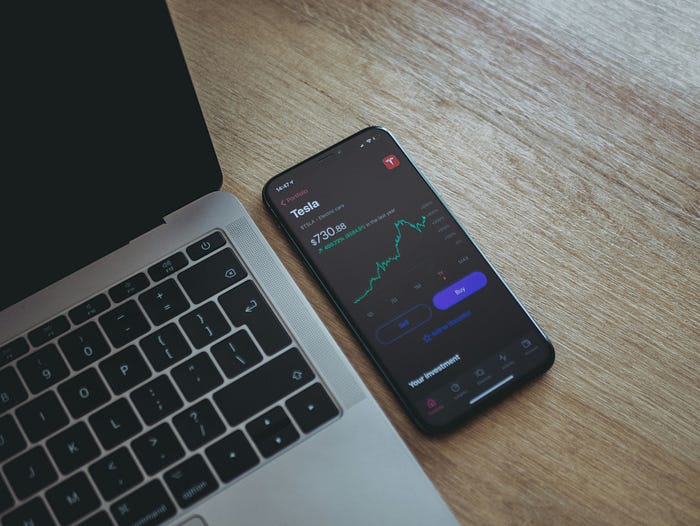
Some of the most valuable wisdom in investing exists in the form of short quotes that distill hard-earned experience and knowledge from expert practitioners and academics into a handful of words.
In this story, I’m going to tell you what I think are the most important quotes in investing. Quotes that every investor can and should learn from, why they’re important, and how they can be applied to everyday financial decisions.
# Saving
For the first quote, we need to start with something that is often underappreciated in investing. Saving.
Saving is a necessary precondition for investing. And for many people, saving will be far more impactful and more reliably impactful than searching for higher investment returns.
This is captured by a classic quote from The Richest Man in Babylon and popularized further by Dave Chilton in The Wealthy Barber.
“Pay yourself first”. The point is that to even have a shot at building wealth through investing, you need to save money, to pay yourself before you have the chance to give in to the societal, biological, and psychological pressures that lead many people to overspend.
Automating your savings is an effective approach. Setting up payroll deductions directly into a retirement account is a great way to do this, if that option is available to you.
Otherwise, setting up automatic contributions from your bank account to an investment account can get you to a similar place.
Figuring out how much to save is a more complex issue. The Wealthy Barber suggests saving 10% of your income, but economists generally suggest saving less early on in your career, when less money is available, and more later as your income increases.
Some research has even suggested that young people should not save at all. I don’t have a strong opinion, as long as you have a plan in place to meet your long-term goals.
With savings out of the way, we can start to think about investing. Investing is as much a psychological endeavor as it is a financial one.
It involves risk and uncertainty about the future, which are quantifiable financial issues. But doing it well requires overcoming the countless behavioral biases that plague investors.
Ben Graham, one of the fathers of financial analysis and of the investment profession as a whole, wrote, “The investor’s chief problem, and even his worst enemy, is likely to be himself.”
Some great quotes address the challenges posed by investor psychology. John Templeton said, “The four most expensive words in the English language are: this time is different.”
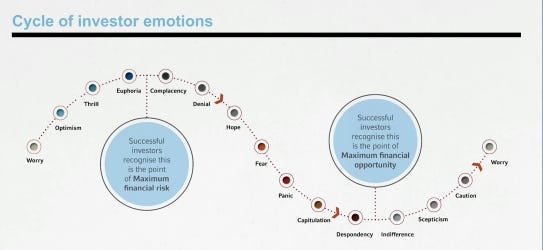
During periods of extreme positive returns, investors search for explanations that not only justify the often accompanying high stock valuations but also justify their continued increases.
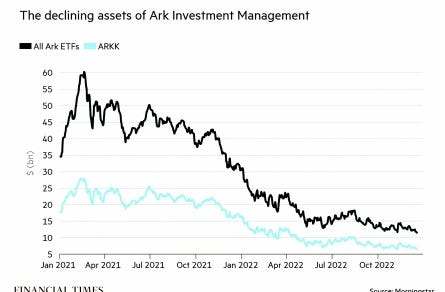
Think of periods like the dot-com bubble, or more recently, the run-up of prices in the holdings of the ARKK ETF.
Many of the investors in those assets were buying stocks at historically anomalous valuations and were literally saying the words Templeton cautioned against. This time is different. The internet changes everything. AI changes everything.
The same thing happens when markets decline. Economist Jeremy Seagull wrote, “Fear has a greater grasp on human action than does the impressive weight of historical evidence.”
What the historical data tell us about market crashes and recoveries, but that won’t always be helpful when fear is in the air.
Investors create narratives about why markets will not recover this time because of whatever is causing prices to decline.
How many times did we hear “unprecedented” during CO? It’s important to acknowledge that every time we see extreme asset price increases or decreases is different.
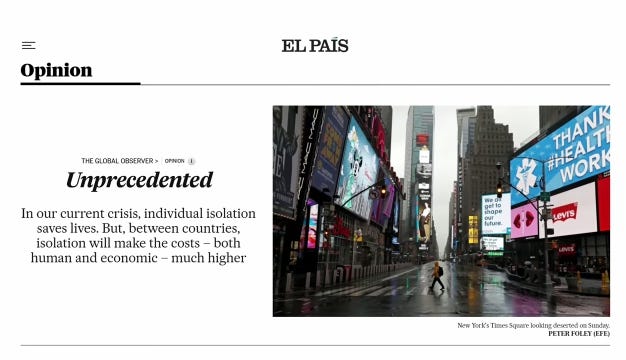
The underlying causes and accompanying narratives are always unique, which is why they cause asset prices to swing wildly.
What doesn’t change is that expected returns for risky assets are positive, and valuations matter, at least eventually. They’re the closest thing to gravity in financial markets.
Investors who want to capture expected returns over the long term need to mentally and financially prepare for bad times and hold assets they’re not going to panic sell, even when things are not working out as expected.
Market declines are never just abstract. They’re psychologically challenging times stemming from deeply emotional and uncertain events.
The COVID-19 pandemic wasn’t just a market decline; it was potentially the end of life as we knew it.
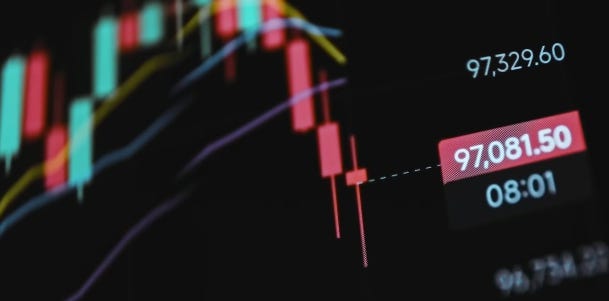
One way to stay grounded through periods of extreme market conditions in either direction is to have conviction in your investment philosophy.
David Booth, co-founder of the academically grounded fund company Dimensional Fund Advisers, said, “The most important thing about an investment philosophy is that you have one that you can stick with.”
The insight here runs deep. Financial markets have generally rewarded long-term, disciplined investors.
But many, if not most, investors sabotage their own returns by moving in and out of investment strategies or styles at precisely the wrong times.
Even an objectively suboptimal investment philosophy, like dividend-focused investing, might be the optimal investment philosophy for some people if the dividends help them to stay disciplined.
The difficult thing about sticking with an investment philosophy is that any strategy, no matter how well-founded its underlying philosophy is, can appear to be wrong for long periods of time.
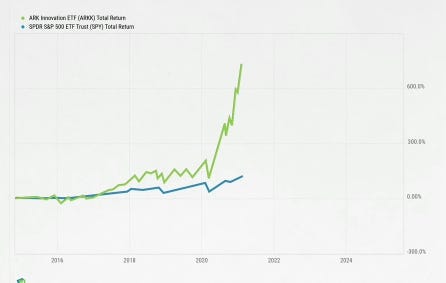
I think ARK is again a good example. When it was on its big run, I heard from many previously disciplined index investors who were considering abandoning their entire investment philosophy because the ARKK narrative was so strong and its manager took direct aim at index funds.
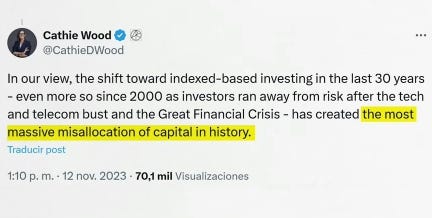
Kathy Wood said that flows into index funds were the most massive misallocation of capital in history and that index funds are overwhelming the old companies at risk of being disrupted while underwriting the disruptors, which ArkK focuses on.
For a while, it seemed like she was right, as ARK skyrocketed, leaving market-cap-weighted index funds in the dust. But it eventually came back to earth, as tends to happen.
Anyone who bailed on their index funds to chase ARK’s returns after it had posted its big gains got burned. And this was the experience of a large portion of the investors in that fund.
Here’s the interesting thing, though. Investors in ARK who truly believed in that investment philosophy, stuck with it from before Kathy Wood was all over the financial media due to ARKK’s incredible short-term performance, and didn’t sell when it eventually crashed, have actually done fine.
I’m not condoning that investment strategy. I don’t think it makes any sense at all, and I think it fundamentally misunderstands the relationship between technological innovation and stock returns.
But my point is that conviction in any investment philosophy will be tested over time. But as long as it leads to a reasonably well-diversified and low-cost portfolio, having an investment philosophy that you can stick with through good times and bad is likely far more important than having the perfect investment philosophy, which unfortunately doesn’t really exist.
Even investors with a solid investment philosophy often get nervous about market corrections. They may consider going to cash to avoid them, or delaying investing new cash.
Fund manager Peter Lynch said, “Far more money has been lost by investors preparing for corrections or trying to anticipate corrections than has been lost in corrections themselves.”
This quote reminds us that while market downturns can hurt, at least in the short run, the opportunity cost of not investing is typically far more expensive.
Investing is inherently risky. It is this very fact that results in positive expected returns and, at least historically, positive realized long-term returns.
The problem is that investors are myopic. They worry about short-term fluctuations, even if they are not short-term investors, and they are loss-averse.
After settling on an investment philosophy and preparing for difficult market conditions, one of the most fundamental decisions that investors need to make is how to allocate their portfolios.
- How much in stocks versus bonds?
- How much is the stock market of each country?
- Which stocks are within each country?
Eugene FMA offers a good starting point. He said, “ You have to talk yourself out of the market portfolio”.
In theory, the market portfolio, the market capitalization-weighted portfolio of all assets, is optimal for the average investor.
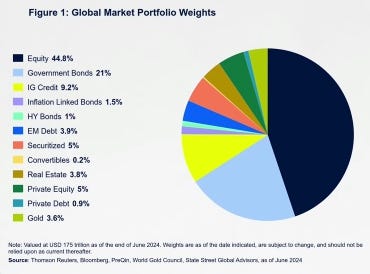
State Street estimates that the investable global market portfolio is about 45% public stocks, 21% government bonds, 9% investment grade corporate bonds, and a whole bunch of other stuff, including gold, real estate, and private equity, making up the remaining 25%.
I’m not suggesting people should actually try to replicate the market portfolio.
But FMA’s point is that while there can be good reasons to be different from the market, it’s important to be clear on what those reasons are and why they apply to you specifically.
For example, a younger person may hold more stocks because they can bear more risk. Someone in a given country might overweight their home country stocks because they’re cheaper and more tax-efficient to own. And someone might avoid private equity altogether due to the asset class’s high fees and lack of transparency.
These kinds of deviations from the market portfolio can make a lot of sense, but it’s still useful to use the market portfolio as a starting point.
Talking yourself out of the market portfolio into owning only three stocks should be really hard to do, as should talking yourself into large allocations to asset classes that make up a small portion of the market portfolio, like private equity.
As allocation is incredibly important because it calibrates the amount of risk you are taking.
One of the reasons that investors struggle with risk is that they don’t really understand what it is.
Risk is often discussed as volatility or the magnitude of short-term declines in asset values, but those are probably not the best measures for long-term investors.
Charles Ellis, author of Winning the Loser’s Game, said, “Risk is not having the money you need when you need it.”
This simple definition captures the fact that risk can either manifest as the inability to fund short-term liquidity needs, highlighting the importance of planning for near-term expenses, for example, by not investing money you need tomorrow in stocks.
Or risk can manifest as the inability to fund future consumption, capturing the importance of earning sufficient expected returns to fund your inflation-adjusted spending in the distant future.
The funny thing is that aversion to short-term volatility exposes investors to more extreme long-term risk.
It is by taking on the risk of volatile assets that investors expect to earn higher long-term returns.
As Morgan Huzle, author of The Psychology of Money, wrote, “Volatility is the price of admission for higher expected returns.”
Not being willing or able to take on the volatility of higher expected return assets like stocks can impair your ability to meet your long-term goals.
Framing risk as the probability of running out of money puts emphasis on what long-term investors should really be focused on.
But even having the right focus doesn’t mean you’re going to get the outcome you hoped for.
No matter how good we think our models are, the future is unknown and unknowable. And that unknown future is what we need to plan for.
Theory and long-term evidence can help point us in the right direction, but they still can’t predict the future.
This doesn’t just apply to investments either. Life has a way of throwing curveballs at you, making it hard to plan for everything.
Economist Elroy Dimpson said, “Risk means more things can happen than will happen.”
Every financial plan should account for the fact that we simply cannot know the range of future outcomes based on what has happened in the past or what we expect to happen in the future.
Investors should maintain a healthy respect for the fact that things will not always work out the way that we want them to, no matter how much data we base our decisions on.
The nature of risk and uncertainty makes investing and planning for the long term inherently uncomfortable.
Financial product manufacturers and active fund managers know that volatility is a struggle for investors, and they are eager to sell you solutions.
Economist John Cochran wrote, “When having dinner with lions, make sure you’re at the table, not on the menu.”
If someone wants to sell you something, a stock or a financial product, you need to ask yourself why they want to sell it to you. What do they know that you don’t? What’s in it for them, and what’s in it for you?
Are you entering into a mutually beneficial transaction, or are you about to be eaten alive by the financial alliance?
There are a ton of financial products out there that cater to the fears and biases of retail investors in exchange for ridiculously high fees and costs, putting retail investors on the menu.
Structured products tend to be one of the most egregious examples, using complexity to shroud extremely high embedded costs.
This is important because fees and costs are one of the few things that investors can actually control.
John Bogle, the founder of Vanguard, said, “The grim irony of investing is that we investors as a group not only don’t get what we pay for, we get precisely what we don’t pay for.”
Bogle is speaking to the fact that, in aggregate, investors have not benefited from paying higher fees to active fund managers who aim to beat the market.
Instead, they have underperformed market indexes roughly by the amount that they paid in fees.
This is what Bill Sharp has referred to as the arithmetic of active management.
As a group, active funds must underperform passive funds because both groups hold the market, but active funds have inherently higher fees and costs.
This grim reality cannot be escaped, but it’s not always obvious.
Investing is a discipline that, due to its inherent risk and uncertainty, contains a lot of noise.
It is very difficult to be certain of anything in financial markets other than the fact that there will be a lot of uncertainty.
The next quote is generally attributed to Mark Twain.
“It ain’t what you don’t know that gets you into trouble, it’s what you know for sure that just ain’t so.”
One of the most dangerous attributes in an investor is overconfidence.
Anytime you think you are sure of something, real estate always goes up. This crypto token is going to the moon.
Tech stocks will always beat the market. The US market will always outperform. This fund manager is brilliant, and so on.
You’ve got to step back and remind yourself that the only certainty in investing is uncertainty.
It’s always worth asking yourself what happens if you’re wrong.
In addition to discipline and psychological fortitude, successful investing requires a good dose of humility and skepticism.
One of the best ways to express humility in investing is through diversification.
If you go all in on a single stock and end up being wrong, you could be setting yourself back permanently.
It’s not uncommon for single stocks to drop 60% or more and never recover.
If you hold a broadly diversified portfolio of stocks, the risk of permanent capital impairment or total loss is significantly reduced.
Harry Markowitz is paraphrased as saying, “Diversification is the only free lunch in investing.”
Typically, as I mentioned earlier, volatility is the price of admission for higher expected returns.
But diversification is a rare case where adding multiple imperfectly correlated risky assets together in a portfolio can allow you to increase expected returns without increasing risk, or decrease risk without decreasing expected returns.
Diversification also mitigates the damage if a single investment in a portfolio does not work out, and it makes you more likely to hold the rare big winners that drive most of the market’s returns.
The downside of diversification is that it makes it less likely that you’ll hit big home runs.
But due to the skewness in individual stock returns, that is, the fact that most stocks perform poorly while a relative few perform exceptionally well, you’re far more likely to pick losing stocks than to pick big winners.
As John Bogle said, “Don’t look for the needle, buy the haystack.”
These quotes boil down to a few key principles.
- Spend less than you earn.
- Keep enough cash on hand for near-term expenses.
- Invest the remainder in a risk-appropriate portfolio with expected returns sufficient to meet your long-term goals.
Choose an investment philosophy and asset allocation that you can stick with even when they don’t seem to be working.
- Don’t try to time the market. Be prepared for the future to be different from your current expectations.
- Be aware of your fees and costs. Don’t be too sure of anything, and diversify broadly.
THANKS FOR READING 🙂
DISCLAIMER: This Article Is Already Published On Medium