The 5 Levels of Self-Discipline — And Why Most People Never Reach the Last One
Understand the stages that turn ordinary habits into powerful self-control.


If you wanna become a more disciplined person, the key to doing that is in this book, “The Power of Habit” by Charles Duhigg, specifically in chapter five on page 142.
Now you might be thinking the answer is building habits, but that’s not it; it’s something different, and it’s hidden in plain sight in one of the studies that he talks about in this book.
Back in the early 90s, just one year after I was born, a psychologist went to a hospital in Scotland and did a study involving patients undergoing knee replacement surgeries.
Now, if you know anything about this type of surgery, you will know that movement and physical rehabilitation are crucial almost immediately after the surgery is done if the patient is going to fully recover their mobility.
But there’s a problem. Moving after a knee replacement is agonizing; it’s incredibly painful. And for that reason, a lot of people who get this type of surgery never fully recover.
So the psychologist took about 60 of these patients and had them write down specific, detailed plans on paper of how they were going to go about their recovery.
And something remarkable happened. The patients who actually wrote down a plan for what they were going to do are much more likely to do it and push through the pain when it came.
And my favorite example was a man who committed to walking to the bus stop every day to meet his wife as she came home from work.
And that right there is the key to self-discipline. It’s hidden in plain sight in that example, and in interactions that we have with people every single day. The key is accountability.
You could also call it duty, the obligations we have to each other.
When your boss tells you to be at work at a specific time, you are there at a specific time because your boss is relying on you.
When your little brother asks you to pick them up from school, you do it because he is relying on you.
- But what about our personal goals?
- What about that instrument you’ve been meaning to learn, or the workout routine you’re trying to stick to?
With these personal goals, there’s nobody else really relying on us. So we can’t really tap accountability to improve our self-discipline, can we?
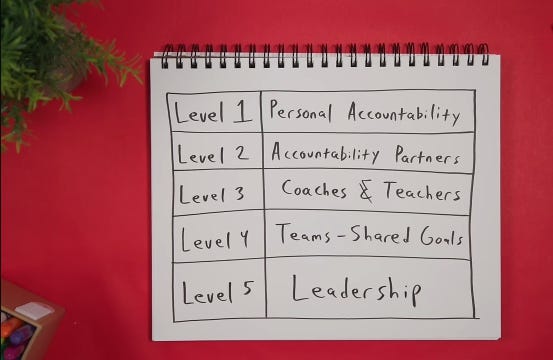
Well, actually, we can. And in this story, we’re going to explore a model that I’m calling the (5 levels of self-discipline).
Each level in this model has to do with a different type of accountability that can be applied to augment and improve your levels of self-discipline.
4 levels in this model have to do with our relationships to other people, and they are the most powerful levels.
But the first one is worth mentioning as well, and that is accountability to yourself.
#.Accountability to yourself: (LEVEL-1)
Now, as the first level, this is the weakest one, but it is not weak per se; it can actually be very powerful. And the study in this book is proof of that.
Now, the man who chose to meet his wife at the bus stop is my favorite example because he involved another person in the equation.
But everyone else who was successful in this study didn’t have anybody else who was really relying on them, yet they were successful because they held themselves accountable.
They made plans and then stuck to them later on.
Every time we make a plan, every time we sit down and write out a task, or add something to our calendar, or decide to do something, we are essentially trying to hold our future selves accountable.
And the study here illustrates how to be more successful with that.
- Number 1:- Make it tangible. Write down what you’re going to do.
- Number 2:- Be specific about it.
Write down exactly what you were going to do and what conditions may cause you to fail.
This last part is also echoed in Seth Godin’s excellent book, “The Dip”.
When he talks about how marathoners often decide what will cause them to quit before they start the race. That way, they are pre-committing to the conditions that would cause them to drop out.
And when the discomfort hits later on in the marathon, maybe 18 or 19 miles in, they’ll know, I committed to other conditions that would make me quit, this is not one of them, therefore I’m going to push through.
Level two is the first level where we introduce relationships to other people.
And in doing so, the accountability becomes so much more powerful because we are a social species.
So while accountability to yourself can be useful, when somebody else is holding your feet to the fire, that is so, so much better.
#. Accountability Partners: (LEVEL-2)
Now, level two is the most casual one in this category, and it involves introducing an accountability partner into the mix.
An accountability partner is somebody who likes you or cares about you, cares about your goals and your progress, and will put in the effort to make sure that you’re doing what you said you were going to do, who actually checks up on you.
This is a rarer person than you might think. And a lot of people fall into a common pitfall where they go around telling all their friends and family about a goal that they have, assuming that these people will hold them accountable.
But what actually happens is they end up sabotaging themselves due to something called a social reality.
This is when you feel like you have actually made some progress on your goal due to the praise you receive from other people after you tell them about it.
You feel like something has happened, but in reality, no progress has been made.
So in general, you shouldn’t go around talking about your goals because you want to avoid these social realities.
But the caveat here is that if you can find somebody who will actually act as an accountability partner, telling them about your goal and having them hold you accountable can be very powerful.
And I have an example here. So, a few years ago, I decided that I wanted to read more non-fiction.
So I went to my best friend, Martin, and I said, I’m going to read 25 pages of nonfiction every single day for the next 3 months.
And if I skip even 1 day, I’m gonna give you $100. So please hold me accountable. And to help him keep me accountable, I also created a spreadsheet for him.
That’s right, it is spreadsheet time once again. So I created a sheet where I would record how many pages I read each day and from what book, and I gave him access to that sheet.
And Martin was actually a great accountability partner. There were some days when I wouldn’t do my reading until like 11:00 p.m.
And on those days, I remember him texting me or coming up and saying, “Hey, why haven’t you done your reading yet?”
And Martin was a particularly good accountability partner because he didn’t really want the $100.
So Martin is definitely a great accountability partner. And if you have a Martin in your life, lean on them the next time you’re having trouble sticking to a goal on your own.
That accountability they bring to the table is like a force multiplier for your self-discipline.
#. Coaches and Teachers: (LEVEL-3)
Now, if you don’t have somebody in your life who can act as a great accountability partner, you can always move up to level 3, which is to hire a coach or a teacher.
Coaches and teachers are essentially professional accountability partners, and they bring some additional benefits to the table.
A great coach is somebody who has the expertise in the thing that you wanna learn.
They can either do it themselves now, they’re at the level you’re trying to get to, or they were at that level one point in their lives and have the experience they can lean on to teach you to get there.
But they also have experience with teaching. And this is really a true skill area unto its own.
Some people are experts, but they fall victim to what’s called the expert paradox, where they are so good at what they do that it’s become like breathing to them. It is second nature, it’s completely unconscious.
And because of that, they don’t know how to break it down into the manageable beginner chunks that somebody at your level needs to actually understand and make progress.
So, a great coach is somebody with both the expertise and the teaching ability, but also someone who is invested in your success.
And this is what separates a great coach from a merely good one, somebody who actually cares about you making progress.
Great coaches, in my experience, often cost a good amount of money. So this is something where you may wanna look for an accountability partner first and then move up to coaching when you have the means, or when you’re very serious about making progress.
#. Teams and Organizations: (LEVEL-4)
Now, level four is a whole different ball game than levels 2 and 3, because with accountability partners and coaches, these people are exerting effort to give you the accountability you need for your personal goals.
And in doing so, you now have other people who are relying on you to do your part, and this makes the accountability so much more powerful.
Now, when it comes to teams, I see two different types in this dynamic here.
First, there are groups of people who have come together to all pursue their personal goals in a group setting.
Think about it like a casual but fast cycling ride on the weekend. There are a lot of these on Meetup here in Denver, and I’ve actually participated in one in the past.
Some of these are what are called drop rides, where if the pack is going faster than you, you are going to get dropped.
Meaning they’re not gonna stop up the road and wait for you and let you rejoin the pack. You get dropped off, and you just need to ride home.
In this instance, you are not really contributing to a common goal so much as you are in a pack of people who are all riding for the camaraderie, but it’s still powerful.
If you see a pack pulling ahead of you and you’re falling behind, well, there’s not a whole lot more in this world that’s gonna make you motivated to really step on the gas and try to keep up with that pack.
But the one thing that is more powerful than that is being part of a team where your input is literally needed for everyone to meet their goal.
Think of a relay race. If you never make it to the area where the next person is waiting for you to pass the baton, they can’t run.
And if you’re slow, they’re never gonna be able to catch up with their competitor.
So whatever your personal goal is, if you can find a team or an organization that you can join where your contributions will be needed, but you can also develop your own abilities, that’s powerful.
The only thing more powerful is level 5.
And before I reveal what this level is, I do wanna say that this is not the domain of life hacks.
This is not a level to go to if you want to add some self-discipline to your own life, but it is a level that has to be included in this model; it would be incomplete.
#. Leadership: (LEVEL-5)
Now, instead of being part of a team and having people rely on you just to do your part, you’ve stepped up into a leadership role, and everyone is relying on you to guide them as well.
When you’re a leader, the accountability is at its highest point, but also the responsibility and the consequences for failure are as well.
So those are the five levels of self-discipline as they pertain to accountability.
Accountability to yourself, to partners, to coaches and teachers, to teams, and to people beneath you when you are in leadership positions.
Now, with accountability partners in general, it can be tough to find good ones who will actually stick with you and hold you accountable.
And in the extended version of this story, I discuss one more way that can be very powerful for finding those accountability partners and developing relationships with them.