What About Warren Buffett? — Lessons From the World’s Most Patient Investor
The mindset that helped Warren Buffett outperform generations of investors.

One of the questions I always get when I tell people that index investing is a good investment strategy is, ” What about Warren Buffett?
The premise is that if it’s possible to beat the market, as Warren Buffett has for longer than I’ve been alive, why would anyone settle for boring market returns with index funds?
Why Warren Buffett does not prove that active management is a smart approach to investing, and why you should take Buffett’s advice instead of trying to emulate his results.
And yes, I will also address Buffett’s cash pile and what it means for most investors.
Since Warren Buffett took control of Berkshire Hathaway in 1965, the stock has returned an annualized 19.8% through the end of 2023, nearly doubling the S&P 500’s return over the same period.
That is incredible, and over such a long period, it has resulted in enormous wealth for anyone who held the stock.
It’s obvious why people question the validity of index investing when investors like Warren Buffett exist.
While the full history back to 1965 is beyond impressive, recent history has been less favorable. Before I continue, I want to say that Warren Buffett is a wealth of knowledge and wisdom, and a pleasure to listen to and read.
I don’t want to come off as disrespectful or dismissive of his success, but Berkshire Hathaway has underperformed a Vanguard US Equity Index mutual fund, net of fees, for the 22 years ending October 2024.
Buffett was asked about Berkshire’s underperformance at the 2020 shareholder meeting. Warren Buffett mentions that his best year managing money was in 1954, when he was managing peanuts, in his words, a relatively small amount of money.
But it’s gotten a lot harder to outperform with larger amounts of money.
He explained that his advice to most people is to invest in S&P 500 index funds, and that while he believes that Berkshire is still a solid investment, he would not bet his life on whether they will beat the S&P 500 over the next 10 years.
Buffett also says that while there may be a few managers out there that can beat the market, it’s very hard for anybody to identify them before the fact.
Once it’s obvious that they are good managers, they run into the same problem as Buffett, of getting too large to continue their outperformance.
This is really the crux of the problem. There’s a simple but important concept in active fund management, diminishing returns to scale.
The larger an active manager’s base of assets gets, the harder it gets for them to outperform the market.
Yes, Warren Buffett is brilliant and has been able to beat the market, but that does not mean that he will be able to continue beating the market forever, as Buffett correctly acknowledges.
This is the same point made in a highly cited 2004 academic paper, where the authors describe an efficient market for manager skill. They suggest that investors will identify skilled managers based on their past performance and allocate to those managers up to the point that they can no longer beat the market.
The result is that the most skilled managers have the largest funds, but their investors simply earn returns in line with the risk they are taking, which they could do much cheaper with an index fund.
Finding the rare good active managers before they become too big is beyond challenging, and finding them once they are known makes it less likely that you will reap the benefits of their skill.
Forgetting about the issue of diminishing returns to scale for a minute, the other challenge is that by the time an active manager has a sufficient track record to prove their skill, there’s a good chance they are close to retirement.
The problem, though, is that while I do not doubt that these men are brilliant, they have so far trailed both Buffett and the market.
It’s even hard for the best active managers to pick future winning managers before the fact.
It should come as no surprise, then, that despite his years of great results and clear business acumen, Buffett is one of the biggest advocates of index investing.
This is something he has come back to repeatedly in his shareholder letters and meetings for decades.
In the 1996 letter to shareholders, Buffett explains that most investors, both institutional and individual, will find that the best way to own common stocks is through an index fund that charges minimal fees.
Those following this path are sure to beat the net results, after fees and expenses, delivered by the great majority of investment professionals.
That has proven to be true again and again, as far back as the data have been tracked. Actively managed funds that attempt to beat the market are much more likely to underperform, and increasingly so at longer horizons.
The other problem is that there’s no evidence of persistence, meaning that picking the best active managers from, let’s say, the last 10 years does not give you a better chance at having winning managers for the next 10 years.
Warren Buffett has so much conviction in his views on index funds that in December 2007, he entered a 10-year bet with, at the time, $1 million on the line.
The bet was that Protegé Partners, an advisory firm well-versed in manager selection, could not pick funds that would beat an S&P 500 Index fund.
Protegé Partners picked five funds of funds containing, in aggregate, more than 200 hedge funds. Warren Buffett won the bet easily.
As he explains in his 2017 letter to shareholders, after winning the bet, Warren Buffett wanted to make the point that investors, in aggregate, are not getting their money’s worth when they pay high fees for investment management, and that most investors are likely better off simply investing in low-cost index funds.
Warren Buffett also puts his money where his mouth is, or at least he will once he passes away. In his 2013 letter to shareholders, he explains that his advice to invest in index funds is essentially identical to certain instructions he has laid out in his will.
One bequest provides that cash will be delivered to a trustee for his wife’s benefit. His advice to the trustee could not be simpler.
Put 10% of the cash in short-term government bonds and 90% in a very low-cost S&P 500 Index fund.
Warren Buffett believes the trust’s long-term results from this policy will be superior to those attained by most investors, whether pension funds, institutions, or individuals who employ
High-fee active managers. Buffett confirmed that this is still the case as recently as the 2020 shareholder event.
In the 2016 letter to shareholders, Buffett does acknowledge that there will be some successful active managers. He says there are, of course, some skilled individuals who are highly likely to outperform the S&P 500 over long stretches.
In his lifetime, though, he has identified early on only 10 or so professionals that he expected would accomplish this feat. Ten or so in his lifetime. That’s something to think about.
Warren Buffett concludes this section of the 2016 letter with this: the bottom line. When trillions of dollars are managed by Wall Streeters charging high fees, it will usually be the managers who reap outsized profits, not the clients. Both large and small investors should stick with low-cost index funds.
The message from Buffett here could not be clearer. He’s often held up as the example of successful active management, but he himself thinks that the vast majority of people should keep it simple and capture market returns using low-cost index funds.
Despite Buffett’s good advice, I know a lot of investors do want to look for an edge.
The good news is that academic research may have been able to explain Buffett’s success using multi-factor asset pricing models.
That means, in simple terms, that Buffett may have systematically held more of certain types of stocks, allowing him to beat the market.
This is interesting because it’s more repeatable than a special ability to pick stocks. A 2018 paper in the Financial Analysts Journal titled Buffett’s Alpha sets out to explain Buffett’s past performance in terms of exposure to known return premiums.
A return premium is like a group of stocks with shared characteristics that have systematically higher average returns.
The authors of Buffett’s Alpha find that accounting for exposure to the market beta, size, value, momentum, betting-against-beta, and quality factors, plus the use of some leverage, largely explains Buffett’s past performance.
In other words, Warren Buffett’s success is explained by his systematic preference for cheap, safe, high-quality stocks, combined with his consistent use of leverage to magnify returns while surviving the inevitable large absolute and relative drawdowns this entails.
In fact, controlling for these factors makes Buffett’s alpha, or his ability as a manager to produce returns in excess of the risk taken through factor exposure, statistically insignificant.
I know that statement is heretical to Buffett acolytes, but it’s true.
It’s important to acknowledge here that explaining Buffett’s performance with the benefit of hindsight does not diminish his outstanding accomplishments as an investor.
It took academic research more than 50 years to catch up and explain Buffett’s results.
But the reality for an investor today is that we do know that these factors exist, that these return premiums exist.
They explain Buffett’s performance, and we can implement them in a more diversified and systematic way than Warren Buffett did.
The authors find that a systematic Buffett-style portfolio, a diversified portfolio that matches Berkshire’s beta, idiosyncratic volatility, total volatility, and relative active loadings, performs comparably to Berkshire Hathaway itself.
Together, this suggests that Buffett’s genius is at least partly in recognizing early on, implicitly or explicitly, that these factors work, applying leverage without ever having to fire sale, and sticking to his principles.
This paper also touches on how Berkshire Hathaway has changed its style over time.
Early on, when the returns were exceptionally high, Buffett favored smaller firms and only became biased toward large firms later in the analysis period.
This suggests again that Buffett’s diminishing returns could be related to capacity constraints, fitting the model of diminishing returns to scale.
Before I conclude, I need to mention Berkshire Hathaway’s increasingly large cash holdings.
This is often referenced as a sign that investors should also be going to cash, or at least that they should be concerned about a potential market crash.
Buffett was asked about this at the 2019 shareholder meeting. An attendee asked, Warren, you are a big advocate of index investing and of not trying to time the market, but by having Berkshire hold such a large amount of cash and T-bills, it seems to me you don’t practice what you preach.
- Warren Buffett had a great answer, as he always does.
He first acknowledges that it is a perfectly decent question and suggests that investing in index funds rather than cash may be a strategy that his successors at Berkshire should employ, because on balance, he would rather own an index fund than carry treasury bills.
Overall, though, he agrees that it’s a perfectly rational observation and acknowledges that looking back on a long bull market, the opportunity cost really does jump out at you.
Buffett goes on to say, and this is the key for most of you watching who I suspect don’t have hundreds of billions in cash, let alone a couple billion, that he would argue that if you were working with smaller numbers, it would make a lot of sense to invest in index funds rather than holding cash while waiting for investment opportunities.
Warren Buffett is one of the greatest investors in history, with a long track record of beating the market. If you can find the next Warren Buffett, you should absolutely invest with them.
But that’s easier said than done, and as the existing Warren Buffett himself will tell you, he is no longer the obvious answer to beating the market, and he hasn’t been for a while.
This illustrates one of the biggest challenges of active management and is consistent with theory and empirical observations on diminishing returns to scale.
Trying to find the next Warren Buffett before the fact is likely to be extremely difficult, as Buffett himself has learned with the performance so far of his successors.
And finding them after the fact is likely too late to benefit from their skill.
Buffett’s advice, in no uncertain terms, is that most investors should simply minimize their costs and invest in low-cost index funds.
I tend to agree with him, though I do depart from Buffett on international diversification. Buffett suggests investing in S&P 500 index funds. I’d add more stocks outside of the US.
For investors who must try to beat the market, the good news is that diversified systematic strategies that tilt toward factors with higher expected returns, like safe, high-quality, cheap stocks plus a bit of leverage, can explain the historical results of Berkshire Hathaway.
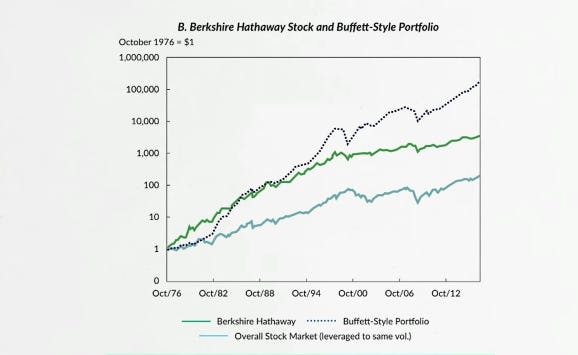
Implementing a systematic strategy in this fashion is more likely to be successful than reading financial statements and picking individual stocks.
THANKS FOR READING 🙂
DISCLAIMER: This Article is Already Published on Medium